


just before Repulse and Renown... very much like them in fact... only one of this class... closer to Kongo which the Japanese had built in the UK... made Royal Navy mad that their builders built better ship than they had so the Tiger was built
HMS Tiger was a battlecruiser of the Royal Navy, built by John Brown and Company, Clydebank, Scotland, and launched in 1913. Tiger was the most heavily armoured battlecruiser of the Royal Navy at the start of World War I
Displacement:
33,677 tons full load
Length: 704 ft (215 m)
Beam: 90.6 ft (27.6 m)
Draught: 28.5 ft (8.7 m)
Propulsion: 4 shaft Brown-Curtis turbines, 85,000 shp
Speed: 28 knots
Complement: 1,109
Armament: 8 × 13.5 inch (343 mm) Mk V naval guns
12 × 6 in 152 mm Mk VII guns
2 × 3 in (76 mm) anti-aircraft guns
4 × 3 lb guns
4 × 21 in (533 mm) torpedo tubes
Armour: Belt: 9 inch
Bulkheads: 5 in
Barbettes: 9 in
Turrets: 9 in
Decks: 3 in
Wednesday, January 7, 2009
HMS Tiger ww1 battlecruiser
HMS Dreadnought battleship pictures


HMS Dreadnought of the Royal Navy was a battleship design by Admiral Sir John "Jackie" Fisher, who became First Sea Lord in 1904, Fisher had originally advocated a Royal Navy based around submarines and fast torpedo boats, and had subsequently tempered his revolutionary ideas with a vision of fast, all-big-gun battlecruisers, which would have the firepower and speed to engage battleships and cruisers, albeit with much less armour protection than the former. Fisher felt that speed was a better defence than armour. Although the battlecruiser concept would become popular in the run-up to World War I, Fisher was nonetheless forced by the Admiralty to create an all-big-gun battleship instead.Dreadnought was laid down and assembled with unparalleled speed in Portsmouth Royal Dockyard. She was laid down on 2 October 1905, and completed just 14 months later in December 1906. Dreadnought represented such a marked advance in naval technology that her name came to be associated with an entire generation of battleships, the "dreadnoughts", as well as the class of ships named after her, while the generation of ships she made obsolete became known as "pre-dreadnoughts".
Dreadnought was the first battleship of her era to have a uniform main battery, rather than having a few large guns complemented by a heavy secondary battery of somewhat smaller guns. She was also the first capital ship to be powered by steam turbines, making her the fastest battleship in the world at the time of her completion.
Tuesday, January 6, 2009
HMS Warspite battleship pictures

15 inch naval gun turrets on HMS Warspite

HMS Warspite re-fueling from a tanker in the Seychelles,June 1942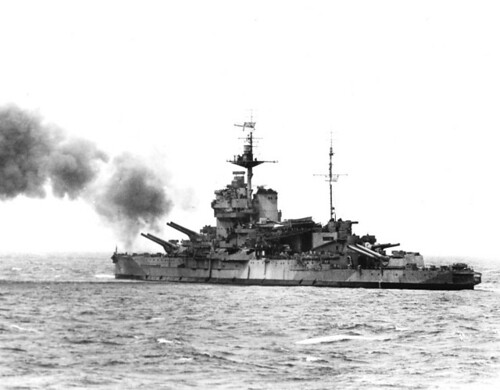
Normandy, June 1944 Costal Bombardment by HMS Warspite long range gunfire support from the Navy
Displacement: As built:
33,410 tons deep
4 × twin 15 inch 381 mm main guns
12 × single 6 inch 152 mm guns
4 × twin 4 inch (102 mm) guns
4 × octuple 2 pdr anti-aircraft guns
4 × quadruple 0.5 cal machine guns
famous british ship hms repulse
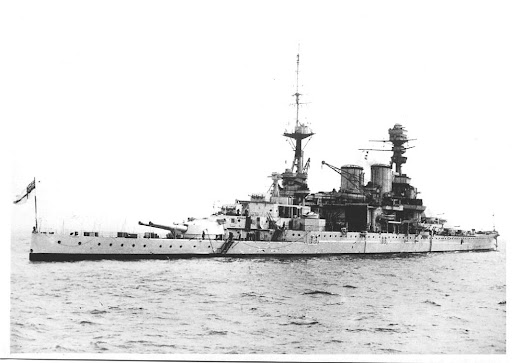

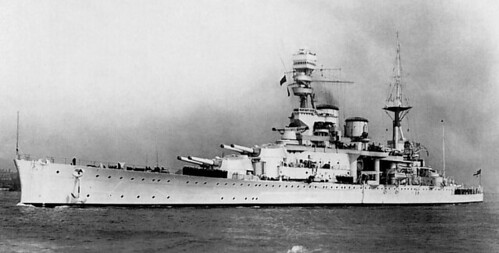
Class and type: Renown class battlecruiser
Displacement: 31,592 tons
Length: 242.07 m
Beam:27.42 m
Draught: 9.0 m
Propulsion: Direct-drive turbines, 4 shafts, 112,000 hp
Speed: 31.7 knots (59 km/h)
Range: 3,650 miles
Complement: 1,181 officers and ratings
Armament: 6 × 15 inch 381 mm naval gun(3×2)
9 × 4 inch (102 mm naval gun low angle (3×3)
8 × 4 inch 102 mm AA gun (2×2, 4×1)
24 × 2-pdr (40 mm) pom-pom (3×8)
8 × 20 mm AA (8×1)
8 × 21 inch (533 mm) torpedo tubes
Aircraft carried: 4 × Blackburn Shark, replaced by Fairey Swordfish in 1939
Aviation facilities: 1 double-ended catapult launcher
hms King George V photos


The hms King George V absolute maximum gun range in 40 degree elevation, is 36,850 yards,In terms of shell weight,KGV used 1,590 pound shells. The KGV's 14-inch guns had quite a few problems initialy in service, namely they could very easily jam in combat. The biggest examples were the HMS Prince of Wales at The Battle of Denmark Straight, and HMS King George V at The last battle of the Bismarck. To be perfectly fair, PoW was a brand new ship that hadn't had all of its kinks ironed out. KGV's problem is attributed more toward fatigue than anything. The gun in terms of operation was based off of the Mark I 15inch/42caliber gun used by the Queen Elizabeth-class, the Revenge-class battleships, the Renown-class Battlecruisers, HMS Hood, etc, in that a heavier shell would be fired from a lower velocity gun. This descion was made, in part due to the fact that the Nelson-class battleship's guns basically fired lighter shells at a higher velocity. The barrel life and reliability of the 16-inch gun used on the Nelson-class was lower than the older 15-inch guns mounted on the aformented warships.
Secondary guns:The King George V mounted a total of sixteen 5.25 dual-purpose guns,The 5.25 DP was a effective weapon, particularly with proximity fuses.
King Geoge V's armoured belt was 15.4 inches thick.the turret armouring at thickest was 12.75 inches thick
Top Speed: King George V's projected top speed was originally 30 knots, but generally accepted top speed is 28 to 29 knots
Fuel range: King Geroge V's maximum nautical range was 5,400 miles. The rational behind the relatively short range of the King George V-class was that it could re-fuel at British bases all around the world. This proved to be more of a liability than an advantage in pratice
Monday, January 5, 2009
british battleship hms Vanguard pictures


HMS Vanguard (B-23) sailing for Her Majesty's Naval Base (HMNB) Portsmouth in late 1940's


Sunday, January 4, 2009


british battle cruiser hood photos


Construction of Hood began at the John Brown & Company shipyards in Clydebank, Scotland, on 1 September 1916
hms hood is one of four Admiral class battlecruisers ordered in mid-1916 under the Emergency War Programme
HMS HOOD "Factoids"
Callsign: GECV
Pendant number: 51
Displacement: 1918: 45,200 long tons (45,900 t) full load;
1940: 48,360 long tons (49,140 t) full load
Length: 860 ft 7 in (262.3 m)
Beam: 104 ft 2 in (31.8 m)
Draught: 33 ft 1 in (10.1 m)
Nicknames:
Public Nickname: The "Mighty Hood"
Crew Nickname: "The Seven Bs" ("Britain's Biggest Bullsh*ttingest B*stard Built By Brown")
Original construction cost was £6,025,000 (of which John Brown & Company, Ltd, reportedly made £214,108.00)
One of the few ships that possessed her own chapel
380 telephones at the time of her loss
3,874 electric light fittings (per late 1930s information)
Nearly 200 miles of permanent electric cable (weighing 100 tons)
General provisions for 4 months amounted to 320 tons, including one month's fresh meat
Breakfast consisted of 100 gallons of tea, four sides of bacon, 300 Ibs of tomatoes, 600 Ibs bread, 75 Ibs of butter
Monthly payroll was approximately £6,000
Fuel consumption at full speed was 3 yards to the gallon
Three times around the ships was one mile
Longest warship completed for Royal Navy to date
Saturday, January 3, 2009
british heavy cruiser drawings


HMS London (C-69)County-class heavy cruiser,London was involved in the pursuit of the German battleship Bismarck in May 1941
main gun 8 inch (203 mm L/50) Mk.VIII in twin mounts


HMS Effingham was a Hawkins-class heavy cruiser of the Royal Navy. She was commissioned at Portsmouth in 1925,In 1937-38 Effingham was given an extensive modernisation which radically changed her appearance. Her boilers were reduced from 12 to 10, as a result of which she was given a single vertical funnel in place of the two raked ones, and vertical masts. Her main armament was changed to nine 6" guns in single mountings
HMS Rodney photos


+leaving+Portland..jpg)
HMS Rodney (pennant number 29) was a Nelson-class battleship of the Royal Navy.
Built under the constraints of the Washington Naval Treaty of 1922, the design was limited to 35,000 tons and showed certain compromises. To accommodate 16 inch (406 mm) main guns in three turrets, all of the turrets were placed forward and the vessel's speed was reduced and maximum armour was limited to vital areas. Even with the design limitations forced on the designers by the treaty, the Rodney and Nelson were regarded as the most powerful battleships afloat until the new generation of all big gun ships was launched in 1936. she joined up with King George V; Admiral Sir John Tovey sent the destroyers home because they were low on fuel, and had Rodney fall in behind King George V for the battle against the Bismarck the next day. On the early morning of 27 May 1941, along with the battleship King George V and the cruisers Norfolk, and Dorsetshire, she engaged the Bismarck, which had had its rudder machinery damaged by a Swordfish-launched torpedo the day before. After Bismarck's guns were knocked out, Rodney closed with Bismarck until she was firing essentially a flat trajectory, and spotters could actually follow the shells to the target. One 16-inch (410 mm) shell was tracked from the gun to where it hit the face of Bismarck's #2 gunhouse (turret Bruno) and exploded, blowing out the back of the gunhouse.
Nelson class battleship specs
specifications
Class and type: battleship
Displacement: 33,950 tons standard, 38,000 tons full load
Length: 660 ft (201 m) p/p, 710 ft (216 m) o/a
Beam: 106 ft (32 m)
Draught: 28.5 ft (9 m), 31.5 ft (9.6 m) full load
Propulsion: 8 × Yarrow-type water-tube boilers (250 psi (1,700 kPa)), Brown-Curtis single-reduction geared steam turbines, 45,000 shp (33600 kW) on 2 shafts
Speed: 23 knots (43 km/h)
Range: 16,500 nmi (30,560 km) at 12 knots (22 km/h)
5,500 nmi (10,190 km) at 23 knots (43 km/h)
Complement: 1,361
Armament: 9 × BL 16 inch Mk.I (406 mm, L/45)), triple turrets Mk.I
12 × BL 6 inch Mk.XXII (152 mm, L/50), twin turrets Mk.XVIII
6 × QF 4.7 in Mk.VIII (120 mm, L/43), single mounts HA Mk.XII
24 × QF 2 pdr Mk.VIII (40 mm, L/39), octuple mount Mk.VIII
16 × QF 0.5 in Mk.III "Vickers" (12.7 mm), quadruple mount Mk.I
2 × tubes for 24.5-inch (622 mm) torpedoes Mk.I
Armour: Belt
14 in, 9–13 in closing bulkheads
Middle deck
6.25 in over magazines, 3 in over machinery spaces
Lower deck
6.25 in over steering gear
Bulkheads
1.5 in longitudinals
16 inch Turrets
16 in faces, 12 in sides, 9 in rears, 7 in roofs
14–15 in barbettes
6 inch turrets
1.5 in faces, 1 in sides, roofs & barbettes
Conning tower
13.5 in sides, 7.5 in roof, 6 in communication tube
Director control tower
6 in sides, 4 in roof
Aircraft carried: 1 (Nelson) / 2 (Rodney) from 1934
Aviation facilities: catapult on 'B' turret (Rodney only)
Friday, January 2, 2009


Wednesday, December 31, 2008





