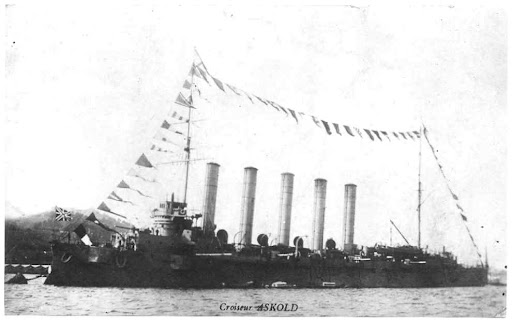
Imperial Russian Navy armored cruiser Askold was launched on 3 March 1900 and served in the Russian Pacific Fleet during both the Russo-Japanese war and World War I. the ships five funnels gave him an easily recognizable outline,She was interned in Shanghai after the Battle of the Yellow Sea and became flagship of the Siberian flotilla in 1906. She was seized by the Royal Navy after the Russian Revolution and renamed as the hms Glory IV
Showing posts with label dreadnought. Show all posts
Showing posts with label dreadnought. Show all posts
Wednesday, January 7, 2009
Russian cruiser Askold
SMS BADEN ww1 german battleship

SMS BADEN, the flag ship of the German Navy in World War One. This Bayern class Battle ship was near 180m long, The class had a displacement of 32,000 tons and mounted eight 380mm 15 inch naval guns in four twin turrets. The secondary guns were placed in casemates just below the deckline. Launched in 1916,some - think this was the basis of the Bismark
Speed: 22 knots (41 km/h)
Range: 5,000 nautical miles (9,300 km) at 12 knots (22 km/h)
HMS Cressy armoured cruiser


HMS Cressy was a Cressy-class armoured cruiser in the british Royal Navy. Cressy was sunk by the German U-boat U-9 in September 1914.
Monday, January 5, 2009
Protected Cruiser Yoshino pictures


Yoshino was a 2nd class protected cruiser of the Imperial Japanese Navy, designed and built by the Armstrong Whitworth shipyards in Elswick, Yoshino was one of the fastest warships with a speed of 23 knots, Yoshino continued to participate in the First Sino-Japanese War, including the Battle of the Yellow Sea on 17 September 1894
Japanese protected cruiser Akitsushima 1890


After the outbreak of the First Sino-Japanese War, Kamimura Hikonojo was assigned command of the new cruiser Akitsushima and won distinction at the Battle of the Yellow Sea on 17 September 1894.
During the Spanish-American War, the Akitsushima (which was then based at Makung in the Pescadores Islands, was sent to Manila in the Philippines to safeguard Japanese interests and citizens.
On 21 March 1898, the Akitsushima was re-designated as a 3rd class protected cruiser. It was called upon for escort duties for Japanese troops and supplies during the Boxer Rebellion.
Considered underpowered, poorly armored, and outgunned by the time of the Russo-Japanese War, the Akitsushima was largely assigned to rear line duties. It was based in the Tsushima islands, and patrolled the sea lanes between Tsushima and Port Arthur. It was in the Japanese 3rd Fleet during the Battle of Tsushima.
Sunday, January 4, 2009


Russian Dreadnought battleship Sevastopol wallpapers


The Sevastopol (Севастополь) was a Russian and Soviet Dreadnought battleship of the Gangut class.
The Sevastopol built at the Baltic Shipyard, St.Petersburg, was laid down 1909, launched in October 1911, and completed in November 1914. Sevastopol-type ships at that time were technically the best military Gangut class ships.[1] In 1914-1918 she fought in the World War I at the Baltic Fleet
italian armored cruiser San Giorgio picture and drawing


The San Giorgio was an Italian cruiser ship of 9232 tons displacement launched in 1908. The San Giorgio was powered by eight oil-burning boilers providing a top speed of 22 knots and a range of 10032 km at 10 knots. She carried a complement of 751 and was armed with four 10-inch guns; eight 7.5-inch guns; eight 3.9-inch guns and six anti-aircraft machine-guns.
ww1 german battlecruiser Lutzow line drawing

SMS Lützow was a Derfflinger class battlecruiser of the Deutschen Kaiserliche Marine during World War I, and the second ship of her class
Built by Schichau-Werft in Danzig, her keel was laid down in May 1912, and she was launched on 29 November 1913.
Lützow was commissioned on 8 August 1915 for trials, but developed major problems with her turbines, which necessitated 6 months of repairs before she was able to enter service. She was finally fully commissioned in March 1916, just over 2 months before the Battle of Jutland.
On completion she displaced nearly 27,000 tons, with a main armament of 8 x 30.5 cm (12 in) guns, making her the largest and most powerful German battlecruiser at the time
Friday, December 19, 2008
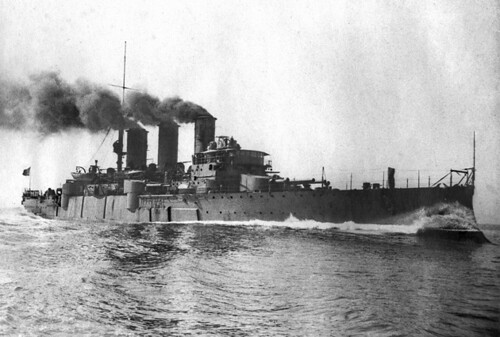


USS Olympia pictures
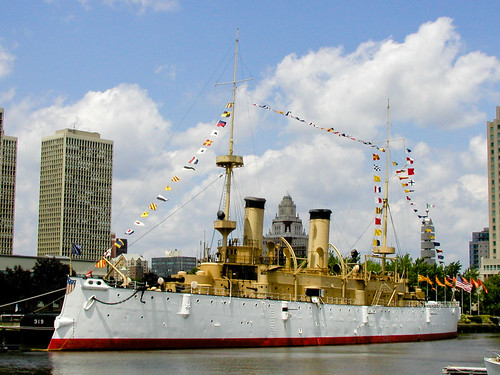
USS Olympia (C-6/CA-15/CL-15/IX-40) was a protected cruiser in the United States Navy during the Spanish-American War. She is most notable for being the flagship of Commodore George Dewey at the Battle of Manila Bay. The cruiser continued in service throughout World War I and was decommissioned in 1922."
Subscribe to:
Posts (Atom)



