
 USS Bunker Hill (CG-52)
 U.S. Sailors and Coast Guard teams conduct counter piracy operations in the Gulf of Aden.

USS Mobile Bay (CG 53) steams through the North Arabian Sea supporting the Nimitz-class aircraft carrier USS Abraham Lincoln (CVN 72)

USS Port Royal (CG 73),
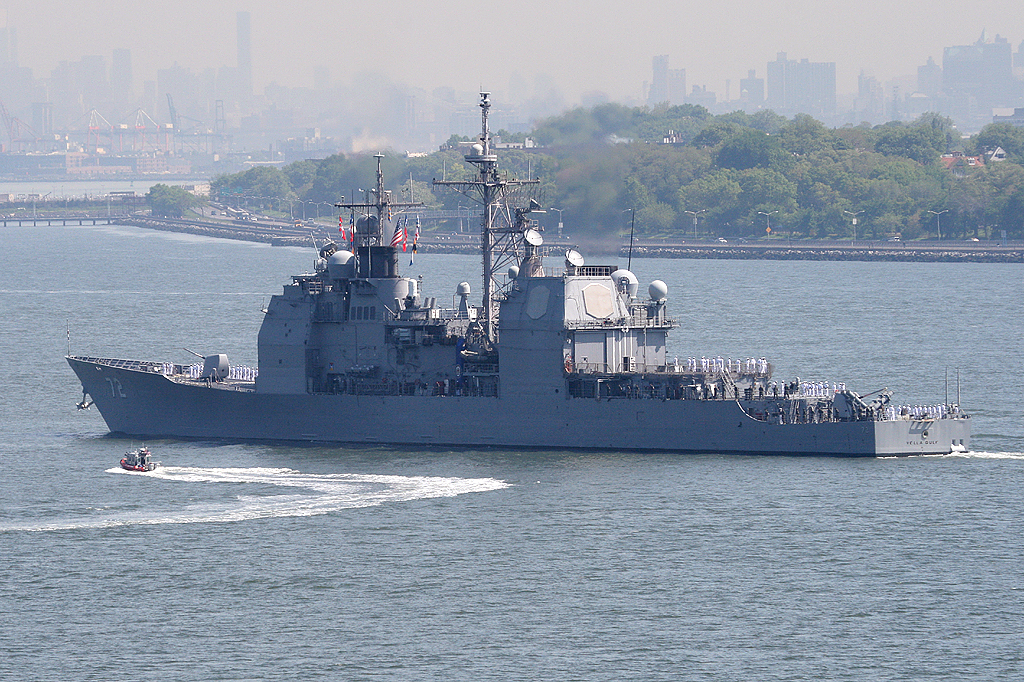 USS Vella Gulf (CG-72), Ticonderoga class Aegis guided missile cruiser, in New York, USA. Fleet Week. May, 2009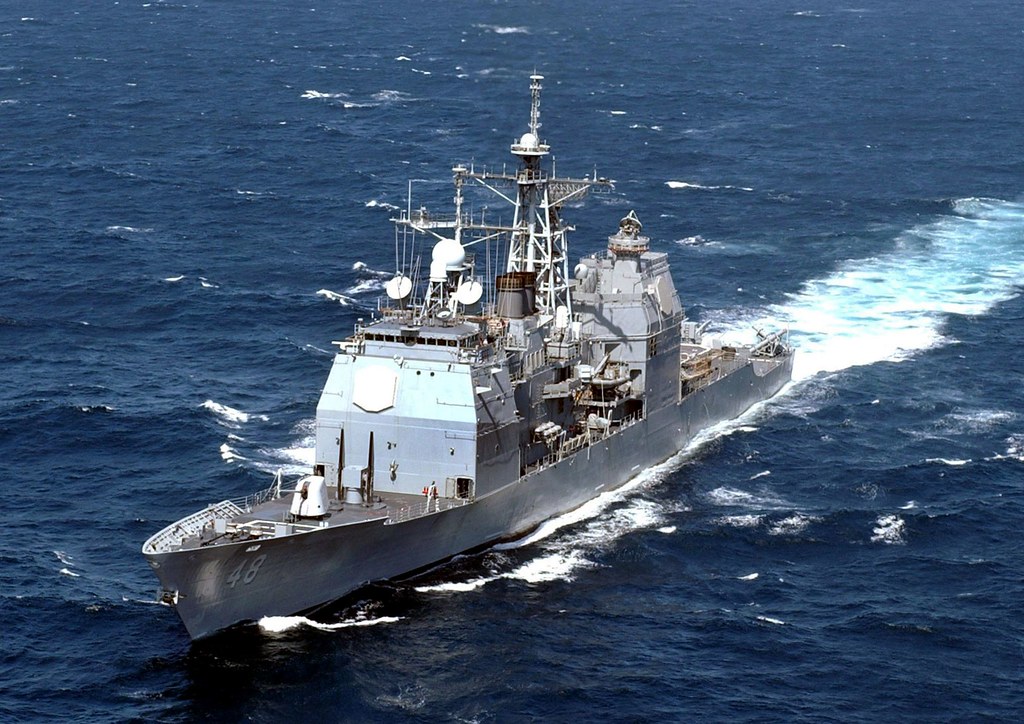
Mark-26 twin-arm missile launcher USS Yorktown CG-48 2002

USS San Jacinto (CG 56) Feb. 24, 1996 -- U.S. Navy's Ticonderoga Class Cruiser USS San Jacinto (CG 56) (center) executes a high-speed break away following replenishment at sea (RAS) operations with the Military Sealift Command Replenishment Oiler USNS Big Horn (T-AO 198)
 USS Lake Champlain (CG-57)
 A harbor tug maneuvers the guided missile cruiser USS VINCENNES (CG 49) toward a pier at Naval Air Station, North Island.
 USS Monterey (CG 61) anchors out in the bay of Naples, Italy, during a recent port visit.
 The guided missile cruiser USS Leyte Gulf (CG 55) is shown underway with the amphibious assault ship USS Wasp (LHD 1) Expeditionary Strike Group (ESG).
 Port bow view of the US Navy (USN) TICONDEROGA CLASS: Guided Missile Cruiser (Aegis) USS VELLA GULF (CG 72) conducting a high-speed turn while underway in the Mediterranean Sea.
 ARABIAN SEA (July 7, 2009) The Ticonderoga-class guided-missile cruiser USS Chancellorsville (CG 62) underway in the Arabian Sea. Chancellorsville is an anti-air warfare, anti-submarine warfare, long-range strike and anti-surface warfare combatant capable of supporting carrier and expeditionary strike groups. The Chancellorsville is currently deployed in the U.S. 5th Fleet area of operations

Ticonderoga Class Cruiser, USS Normandy entering Portsmouth Harbour
Displacement: approx. 9,600 tons full load
Length: 567 feet (173 m)
Beam: 55 feet (17 m)
Draught: 33 feet (10 m)
Propulsion: 4 × General Electric LM2500 gas turbines, 2 shafts, 80,000 shp (60 MW)
Speed: 32.5 knots (60 km/h)
Range: 6,000 nautical miles (11,000 km) at 20 knots (37 km/h); 3,300 nautical miles (6,000 km) at 30 knots (56 km/h).
Complement: 33 officers & 327 enlisted
Sensors and
processing systems: AN/SPY-1A/B multi-function radar
AN/SPS-49 air search radar
AN/SPG-62 fire control radar
AN/SPS-55 surface search radar
AN/SPQ-9 gun fire control radar
AN/SQQ-89(V)3 Sonar suite, consisting of
AN/SQS-53B/C/D Active sonar
AN/SQR-19 TACTAS Passive sonar
AN/SQQ-28 Light airborne multi-purpose system
AN/SLQ-32 Electronic Warfare Suite
Electronic warfare
and decoys: Mark 36 SRBOC
AN/SLQ-25 Nixie
Armament: mark 41
2 × 61 cell Mk 41 vertical launch systems
122 × RIM-66 SM-2, RIM-162 ESSM, BGM-109 Tomahawk, or RUM-139 VL-Asroc
8 × RGM-84 Harpoon missiles
2 × Mark 45 5 in / 54 cal lightweight gun
2 × 25 mm
2–4 × .50 cal (12.7 mm) gun
2 × Phalanx CIWS
2 × Mk 32 12.75 in (324 mm) triple torpedo tubes

USS San Jacinto (CG 56) Feb. 24, 1996 -- U.S. Navy's Ticonderoga Class Cruiser USS San Jacinto (CG 56) (center) executes a high-speed break away following replenishment at sea (RAS) operations with the Military Sealift Command Replenishment Oiler USNS Big Horn (T-AO 198)
USS Lake Champlain (CG-57) A harbor tug maneuvers the guided missile cruiser USS VINCENNES (CG 49) toward a pier at Naval Air Station, North Island. USS Monterey (CG 61) anchors out in the bay of Naples, Italy, during a recent port visit.
 The guided missile cruiser USS Leyte Gulf (CG 55) is shown underway with the amphibious assault ship USS Wasp (LHD 1) Expeditionary Strike Group (ESG). Port bow view of the US Navy (USN) TICONDEROGA CLASS: Guided Missile Cruiser (Aegis) USS VELLA GULF (CG 72) conducting a high-speed turn while underway in the Mediterranean Sea. ARABIAN SEA (July 7, 2009) The Ticonderoga-class guided-missile cruiser USS Chancellorsville (CG 62) underway in the Arabian Sea. Chancellorsville is an anti-air warfare, anti-submarine warfare, long-range strike and anti-surface warfare combatant capable of supporting carrier and expeditionary strike groups. The Chancellorsville is currently deployed in the U.S. 5th Fleet area of operations
Ticonderoga Class Cruiser, USS Normandy entering Portsmouth Harbour
Displacement: approx. 9,600 tons full load
Length: 567 feet (173 m)
Beam: 55 feet (17 m)
Draught: 33 feet (10 m)
Propulsion: 4 × General Electric LM2500 gas turbines, 2 shafts, 80,000 shp (60 MW)
Speed: 32.5 knots (60 km/h)
Range: 6,000 nautical miles (11,000 km) at 20 knots (37 km/h); 3,300 nautical miles (6,000 km) at 30 knots (56 km/h).
Complement: 33 officers & 327 enlisted
Sensors and
processing systems: AN/SPY-1A/B multi-function radar
AN/SPS-49 air search radar
AN/SPG-62 fire control radar
AN/SPS-55 surface search radar
AN/SPQ-9 gun fire control radar
AN/SQQ-89(V)3 Sonar suite, consisting of
AN/SQS-53B/C/D Active sonar
AN/SQR-19 TACTAS Passive sonar
AN/SQQ-28 Light airborne multi-purpose system
AN/SLQ-32 Electronic Warfare Suite
Electronic warfare
and decoys: Mark 36 SRBOC
AN/SLQ-25 Nixie
Armament: mark 41
2 × 61 cell Mk 41 vertical launch systems
122 × RIM-66 SM-2, RIM-162 ESSM, BGM-109 Tomahawk, or RUM-139 VL-Asroc
8 × RGM-84 Harpoon missiles
2 × Mark 45 5 in / 54 cal lightweight gun
2 × 25 mm
2–4 × .50 cal (12.7 mm) gun
2 × Phalanx CIWS
2 × Mk 32 12.75 in (324 mm) triple torpedo tubes





